

$200,000
Per bad merchant, Mastercard
For each merchant caught selling illegal or brand-damaging goods. Up to 100% off if the payment company found it first.
Mastercard SPME §8.8.3, §8.9.3

AI agents for merchant risk
Mastercard takes up to 100% off a merchant fine when you found the problem first. Meerkat's agents check every site a merchant runs in under three minutes, tie each finding to the rule it breaks, and hand your team a signed file that holds up in an audit.
Before a shop can take Visa or Mastercard, a payment company (an acquirer, a PSP or a payment facilitator) has to approve it. That company carries the risk.
If the shop sells something it shouldn't, or turns out to be a scam, Visa and Mastercard fine the payment company. Up to $200,000 per merchant.
An analyst with a browser and a spreadsheet. It takes days, most of the site never gets read, and the file rarely shows why a merchant was approved.
Why now
Both schemes raised the stakes in 2026, and EU law follows in 2027. Payment companies need more checks on more merchants, more often, with a record of who decided.
For each merchant caught selling illegal or brand-damaging goods. Up to 100% off if the payment company found it first.
Mastercard SPME §8.8.3, §8.9.3

For processing gambling, pharmacy, crypto or adult merchants without registering them, plus $2,000 per merchant per month.
Visa Core Rules §12.5.5.1
Since July 2026, Mastercard expects an investigation within 72 hours of the first warning signs.
Mastercard SPME §7.2.1

Every merchant file gets an expiry date, across the whole existing book, and AI-made decisions need a person to review them.
AMLR (EU) 2024/1624 Art. 26(2), 76(5)
How it works
Upload a file of merchant IDs with every website each merchant uses, or send a single application. Nothing for the merchant to fill in.
Specialist agents work in parallel, the way a team of analysts would, and finish in under three minutes.
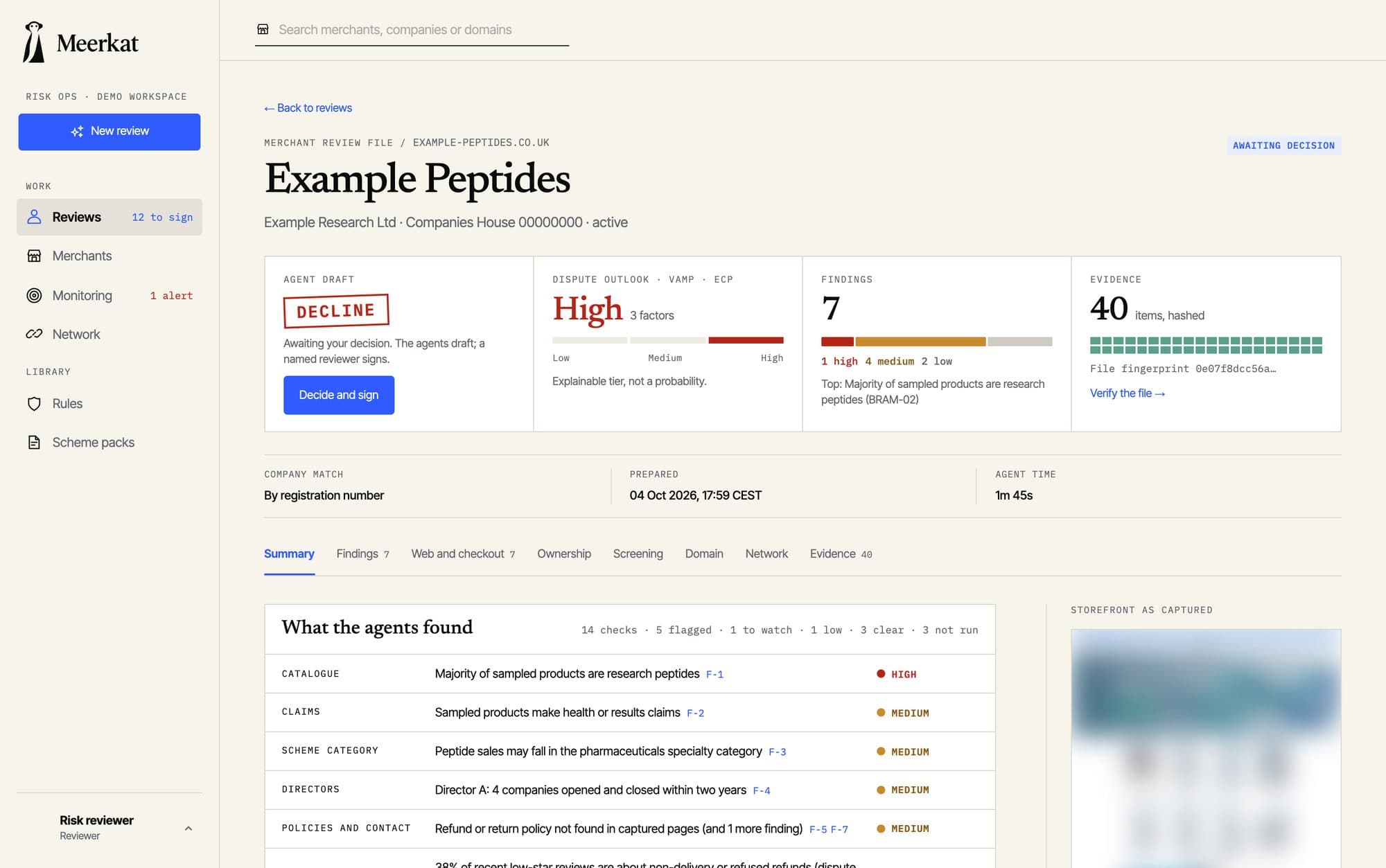
Set each rule to block, add a condition, ask the merchant or just note it. Accept a known exception once, with the reason, and it stays accepted.
Exception: KYB-05 accepted up to low for marketplaces. Reason kept with the version.
Every finding comes with its evidence and the rule it breaks. Your analyst confirms or dismisses each one, then approves, adds conditions, declines or escalates.
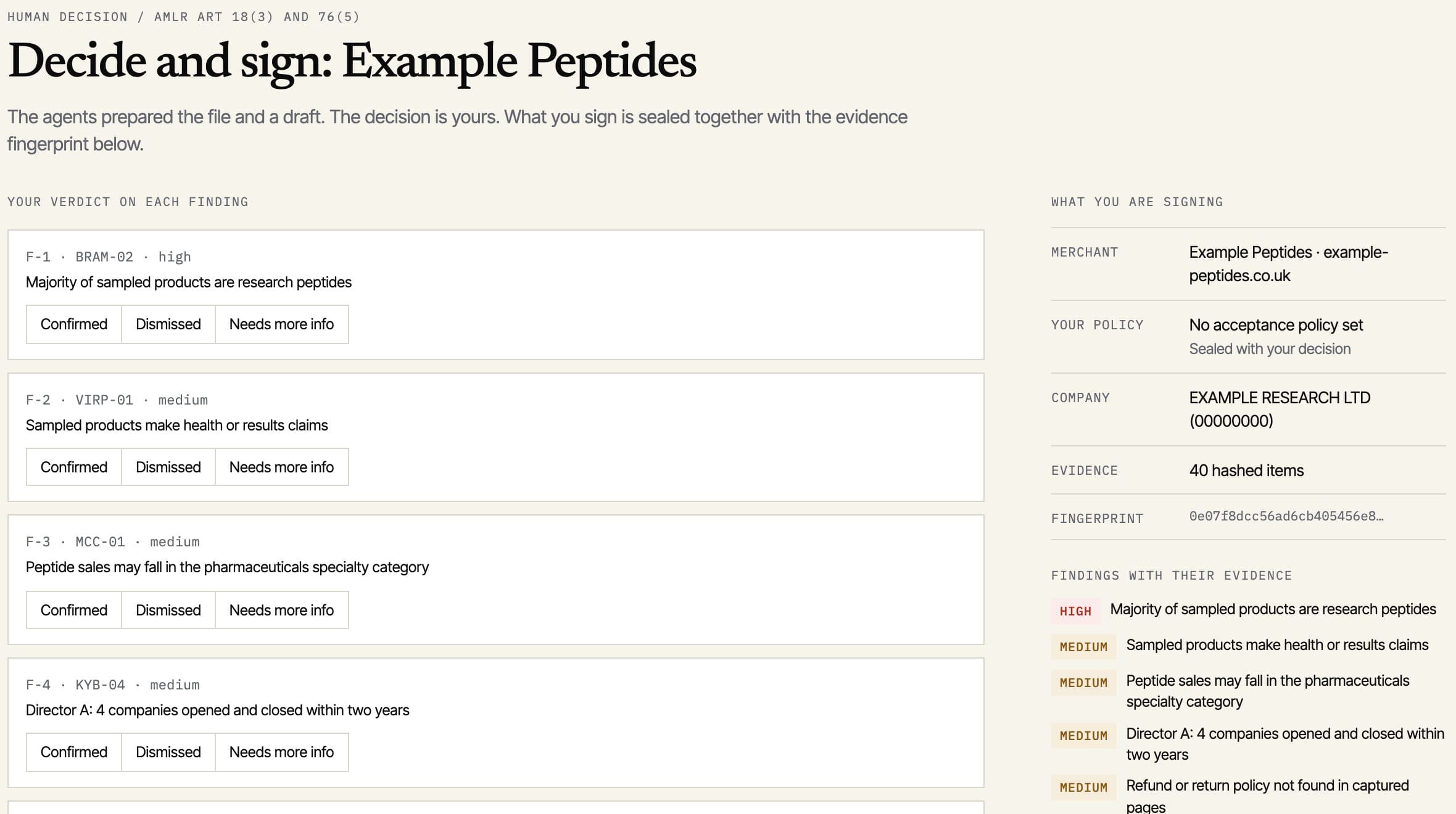
Evidence and decision are locked together with one fingerprint. Change a byte and it no longer matches.
After boarding, Meerkat re-checks every site on a schedule set by its risk, including the payment page and the members area, and raises an alert when something material changes.
Re-checks run weekly, monthly or quarterly, set by risk.
The file
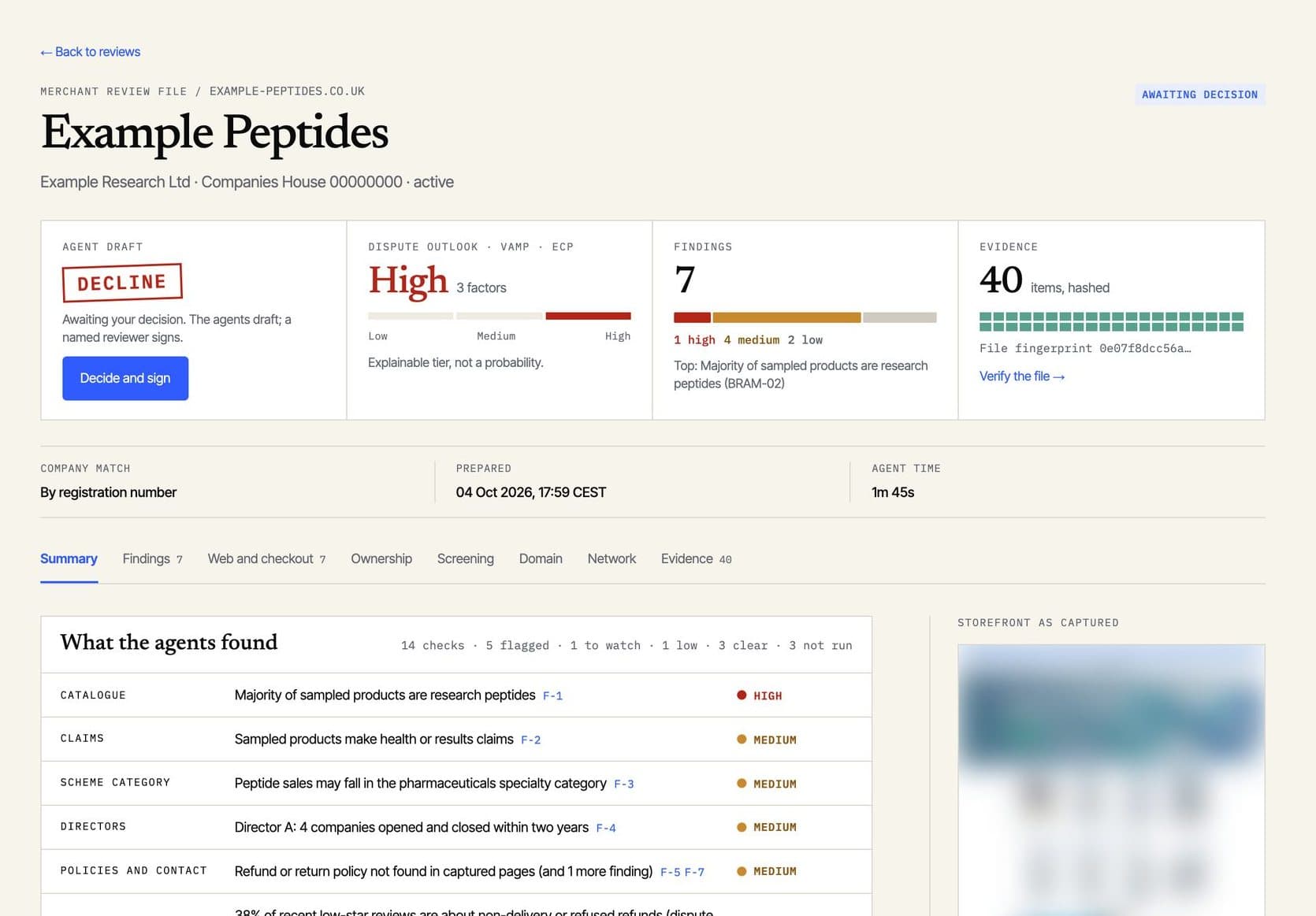
The verdict, the dispute outlook and every check sit on one screen, flagged checks first. Each finding shows the page it came from, the words that triggered it and the rule it breaks.
What we check
Visa and Mastercard tell payment companies what to review before approving a merchant: the website, what it sells, who owns it, whether anyone is on a list. Meerkat does all of it on every merchant, then goes further: the domain's past, the directors' other companies, the shops they run elsewhere.
The registry record, and who really controls it.
Their other companies, and how those ended.
What the website sold before, from the web archive.
Formation agents, virtual offices and mail-forwarding addresses.
Every page a customer sees, including the checkout.
What is really for sale, item by item.
The MCC it declared against the one it should have.
Recurring billing that is hard to see or hard to cancel.
Sanctions, politically exposed people, regulator warnings.
News about the company and the people behind it.
Other shops run by the same people.
Your do-not-board list, and the MATCH result your team records.
Goods that never arrive, refunds refused.
Missing or misleading policies that drive disputes.
A risk tier against Visa and Mastercard dispute limits.
Does what the merchant told you match what the agents found?
The rules
Meerkat tracks every Visa, Mastercard and EU rule change with its source and start date. When a rule changes, it tells you which of your merchants are affected, without running the checks again.
Mastercard BRAM
Mastercard monitoring
Mastercard asks for every merchant URL to be monitored completely, including the payment page and members-only areas, with violations reported on a clock. Meerkat is built to do that job end to end.
Built around you
Your policy
Per rule: block, add a condition, ask the merchant or note it. Exceptions carry a reason and are sealed with the decision.
Your team
A solo admin signs alone. A team adds a second signer on high-risk files or on every file. Viewers read, reviewers decide, admins run the workspace. Everyone signs in with two-factor, and people only see what they can use.
Your stack
Upload your book in one file. Start reviews and get results through the API, with webhooks when a review completes or a merchant changes. MATCH results and your do-not-board list live in the same file.
Works with
Official registries, scheme lists, sanctions data and the open web, read by agents and saved as evidence. Meerkat sits after your identity checks and before your transaction monitoring, and hands both a better file.


 Handelsregister


 OFAC
OFAC Office of Financial Sanctions Implementation



Founder
For two decades Dwayne Gefferie has worked at the frontier of data, analytics and machine learning inside financial services. He was the first data scientist at Adyen, Head of Data at Dimebox and VP of Data Science and Analytics at Checkout.com, then founded DataBright, a data consultancy that helped more than 50 of the world's top 150 acquirers move from on-premise to the cloud.
As an independent consultant he has helped create more than 20 acquiring and issuing banks, including Buut for ABN AMRO's Tikkie. He is the author of Mastercard's acquiring courses, a sought-after speaker, and publishes the Payments Strategy Breakdown newsletter on Substack, read by more than 8,000 C-level executives and managers. Favikon ranks him among the top 10 payments influencers worldwide.
He has a track record of arriving just as an industry breaks out: Adyen and Checkout.com, then DataBright at the start of the cloud analytics wave, where he helped Snowflake, Looker and Fivetran land their first clients in the Netherlands, Belgium and the UK. As a data scientist and payments strategist, he believes agents will reshape how payments companies work. Meerkat is that idea, built.
Dwayne Gefferie · Founder
Pilot
The EU rules reach your existing merchants on 10 July 2027. A pilot now gives you a measured baseline before then.
Hosted in Frankfurt. Built for EU data residency.